Overview
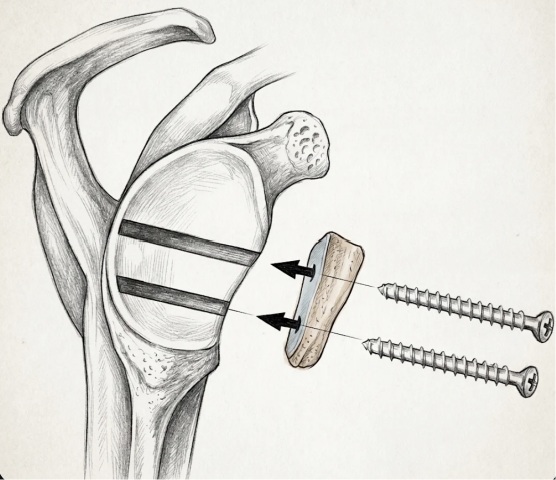
The Latarjet procedure transfers the coracoid process with the conjoint tendon to the anterior glenoid, usually fixed with two screws. It stabilises the shoulder by three mechanisms: bone block, a sling effect from the conjoint tendon, and capsular repair.
Indications
- Recurrent anterior instability with significant glenoid bone loss.
- Off-track Hill-Sachs lesion.
- Failed prior soft-tissue stabilisation.
- Contact and collision athletes at high risk of recurrence.
Preoperative planning
- Setup and patient positioning: Beach chair position, rolled drape under the scapula, Caster Braine Arm support5.
- Surgical steps 6,7./ Approaches/ Closure
Procedure
| Surgical steps | Equipment / retractors | Dangers, tips & tricks |
|---|---|---|
| Coracoid harvesting |
|
|
| Coracoid preparation |
|
|
| Subscapularis split |
|
|
| Anterior glenoid exposure |
|
|
| Extracapsular CP fixation |
|
|
Post-operative instructions
- X-ray in recovery room.
- Arm sling for 2/52.
- No PT/ Liotard self-rehab program starting on day 3 (elevation, external rotation)9,10.
- Clinical review and start PT in 3/12 (muscular strengthening, proprioception, re-athletisation).
- X-ray (axillary Bernageau view) in 3/12
Alternative Procedures
- Arthroscopic Trillat.
- Flipped Lattarjet.
- Dynamic anterior stabilisation.
- Arthroscopic Latarjet.
- Open Eden Hybinette (Iliac Bone Graft).
- Distal Clavicle Autograft.
- Distal tibia allograft.
- Revision Bankart repair + H-S Remplissage.
Pain post Latarjet procedure algorithm
- Clinical examination: Residual instability ->CT scan, MRI arthrogram ->Conservative/DAS/Revision
- X-ray: Bone block failure/resorbtion/malposition, screw impingement ->Bone Bloc Revision, screw removal.
- Shoulder arthroscopy: identify other injuries.
- Infection workup.
Risks
The musculocutaneous and axillary nerves lie close to the field and can be injured by traction or screw placement. Other problems are graft non-union or resorption, screw prominence and, in the long term, glenohumeral arthritis.
Key points
- A robust option when bone loss makes soft-tissue repair unreliable.
- Graft position and screw length are technique-critical.
- Know the nerve anatomy around the coracoid.
References:
1. Swan J, Boileau P, Barth J. Arthroscopic Trillat Procedure: A Guided Technique. Arthroscopy Techniques. 2020;9(4):e513-e519. doi:10.1016/j.eats.2019.12.004
2. Raiss P, Campagnoli A, Bachmaier S, Anderl M, Wittmann T. The Subscapularis-Sparing “Flipped Latarjet” Procedure. Arthroscopy Techniques. 2024;13(4):102899. doi:10.1016/j.eats.2023.102899
3. Rattier S, Druel T, Hirakawa Y, Gröger F, van Rooij F, Neyton L. Use of Cannulated Screws for Primary Latarjet Procedures. Orthop J Sports Med. 2022;10(8):23259671221117802. doi:10.1177/23259671221117802
4. Latarjet Procedure: “From Patient Positioning to Skin Closure.” Vumedi. Accessed October 31, 2026. http://www.vumedi.com/video/latarjet-procedure-from-patient-positioning-to-skin-closure/
5. The Open Latarjet Procedure in 5 Comprehensible Steps. Vumedi. Accessed October 31, 2026. http://www.vumedi.com/video/the-open-latarjet-procedure-in-5-comprehensible-steps/
6. Latarjet-Patte Procedure. Vumedi. Accessed October 31, 2026. http://www.vumedi.com/video/latarjet-patte-procedure/
7. History of the Latarjet Procedure. How Did We Start? | Gilles Walch, MD | SDSI Shoulder Course 2018 - YouTube. Accessed October 31, 2026. https://www.youtube.com/watch?v=38h3IEjP3_s
8. Liotard JP. Rééducation d’une épaule douloureuse : comment faire simple. Revue du Rhumatisme Monographies. 2010;77(3):239-245. doi:10.1016/j.monrhu.2010.04.007
9. Roulet S, Borel F, Franger G, Liotard JP, Michelet A, Godenèche A. Immediate self-rehabilitation after open Latarjet procedures enables recovery of preoperative shoulder mobility at 3 months. Knee Surg Sports Traumatol Arthrosc. 2019;27(12):3979-3988. doi:10.1007/s00167-019-05635-8